EXPERT ANSWERS TO YOUR MOTOR CORE MANUFACTURING QUESTIONS
Find comprehensive answers to the most common technical and commercial questions regarding tungsten carbide progressive dies, electrical steel stamping, and mass lamination production. Can’t find what you are looking for? Our engineering team is ready to assist you.
TOOLING DESIGN & MANUFACTURING
What is the difference between progressive dies and compound dies for motor cores?
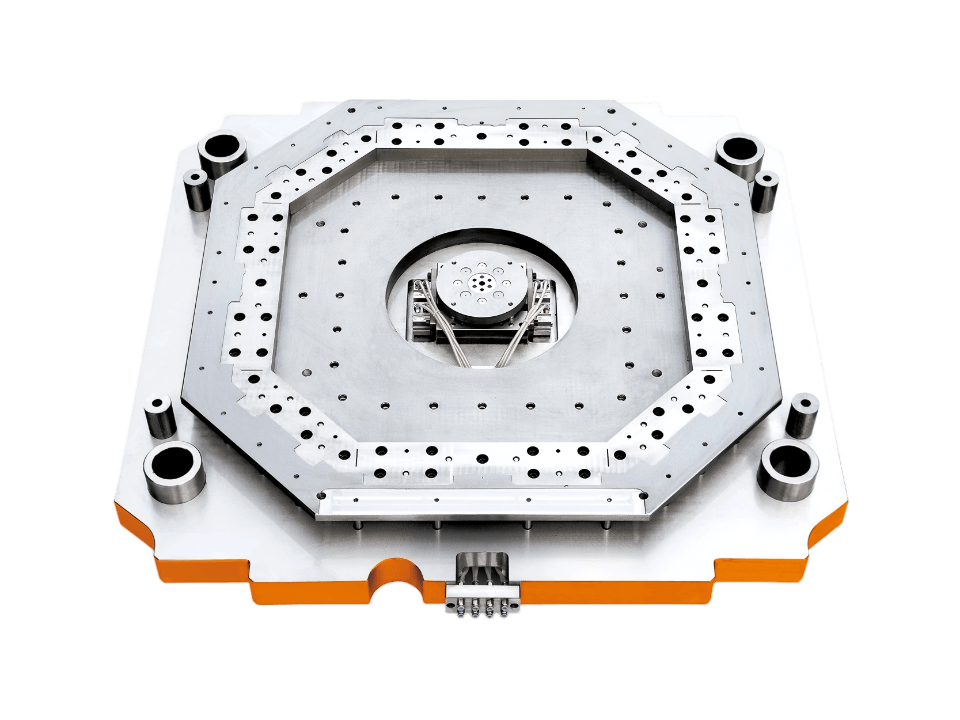
A progressive die performs multiple operations (piercing, blanking, interlocking) across several stations in a single high-speed press stroke, ideal for high-volume production of small to medium stators and rotors. A compound die performs all cutting operations in a single station, ensuring 100% concentricity and flatness, which is highly cost-effective for large-diameter generator cores or lower-volume runs.
What is the guaranteed lifespan of your tungsten carbide progressive dies?
By utilizing premium ultra-fine grain tungsten carbide from brands like Sandvik and Kennametal, combined with our sub-micron machining precision, our progressive dies are guaranteed for a lifespan of 120 million strokes with proper maintenance.
How often does a carbide progressive die need regrinding?
The regrinding interval depends on the material thickness and grade. However, under typical high-speed stamping conditions using 0.50mm CRNGO steel, our carbide dies typically achieve 3,000,000 to 5,000,000 strokes per regrind.
Can your dies perform automatic in-die rotor skewing?
Yes. We design custom progressive dies with integrated rotary skewing mechanisms. This automatically rotates each rotor lamination by a precise micro-angle during the stacking process, effectively eliminating cogging torque and reducing NVH noise in your motors.
STAMPING & CORE ASSEMBLY TECHNOLOGIES
What is Backlack (adhesive bonding) and when should we use it?
Backlack is a technology where laminations are coated with a heat-activated adhesive resin. During or after stamping, heat is applied to bond the entire stack together. It eliminates the mechanical stress and magnetic bottlenecks caused by interlocking or welding, making it the ultimate choice for high-efficiency, ultra-high-speed motors (like EV traction and drone motors).
How do you control burr height during high-speed lamination stamping?
Excessive burrs cause inter-lamination short circuits and increase eddy current loss. We control burrs strictly under 0.01mm (and <0.005mm for aerospace) by maintaining sub-micron clearances between our optical-ground punches and matrices, and enforcing strict IPQC regrinding schedules.
What is a segmented stator and why is it used?
A segmented stator consists of individual stamped teeth (segments) rather than a full continuous ring. This design allows OEMs to use concentrated copper windings, drastically increasing the slot fill factor (up to 90%+) to maximize power density. It is highly popular in BLDC, drone, and EV motors.
Do you offer prototype stamping before committing to a mass-production die?
Absolutely. We offer precision wire-EDM and laser-cutting services for prototyping. This allows your R&D team to validate magnetic flux, thermal limits, and motor efficiency before investing the Capex into a high-speed progressive die.
MATERIALS & SPECIFICATIONS
What thicknesses of electrical silicon steel do you commonly stamp?
We stamp a full range of Cold Rolled Non-Grain Oriented (CRNGO) silicon steel. For standard industrial and appliance motors, we use 0.50mm and 0.65mm. For high-speed EV and BLDC motors, we specialize in ultra-thin gauges including 0.20mm, 0.30mm, and 0.35mm. We even process 0.15mm for extreme aerospace applications.
Why use 0.20mm silicon steel for EV and drone motors?
High-speed motors (spinning at 20,000 to 100,000+ RPM) generate massive high-frequency eddy current losses, leading to severe heat. Using ultra-thin 0.20mm electrical steel drastically reduces these losses, keeping the motor cool and maximizing battery range/flight time.
Can you stamp Cobalt-Iron alloys (e.g., Hiperco 50) for aerospace?
Yes. Cobalt-Iron alloys offer the highest magnetic saturation available, crucial for maximizing thrust-to-weight ratios in aerospace and defense applications. We have dedicated tooling strategies to manage the unique brittleness and abrasive nature of these premium alloys.
QUALITY CONTROL & CERTIFICATIONS
What is your standard concentricity tolerance for stamped motor cores?
Utilizing multi-stage pilot pins in our dies and Sodick EDM machining, we consistently achieve a concentricity tolerance of ±0.01mm to ±0.02mm, ensuring perfect air gaps and zero rotor eccentricity. Every batch is verified using our Zeiss Coordinate Measuring Machines (CMM).
Are your manufacturing processes certified for the automotive industry?
Yes. Our production facilities operate under strict IATF 16949 and ISO 9001:2015 quality management systems. We supply Tier 1 automotive clients globally with full traceability and defect-prevention protocols.
Can you provide PPAP documentation and material traceability?
Yes. Upon request, we provide comprehensive Production Part Approval Process (PPAP Level 3) packages, including FAIR, Control Plans, FMEA, and Mill Test Certificates (MTC) linked directly to your batch tracking codes.
LEAD TIME & COMMERCIAL TERMS
What is the typical lead time for a custom progressive die?
Depending on the complexity, dimensions, and number of stations, a high-speed tungsten carbide progressive die typically takes between 45 to 65 days from final DFM approval (T0) to the first trial stamping sample submission.
How do you prevent dies and motor cores from rusting during ocean shipping?
We take anti-corrosion extremely seriously. Motor core stacks are often treated with steam blueing. For shipping, all dies and cores are coated in premium VCI (Volatile Corrosion Inhibitor) anti-rust oil, wrapped in VCI film, and vacuum-sealed inside robust, fumigated wooden crates designed for long-haul maritime transport.
STILL HAVE UNANSWERED QUESTIONS?